Oskii is inventory software for local game stores: a counter kiosk your customers search themselves, a pick list on your staff’s own phones, and card counts that stay honest between scans. Be the LGS that has it together day one and beyond.
On the counter
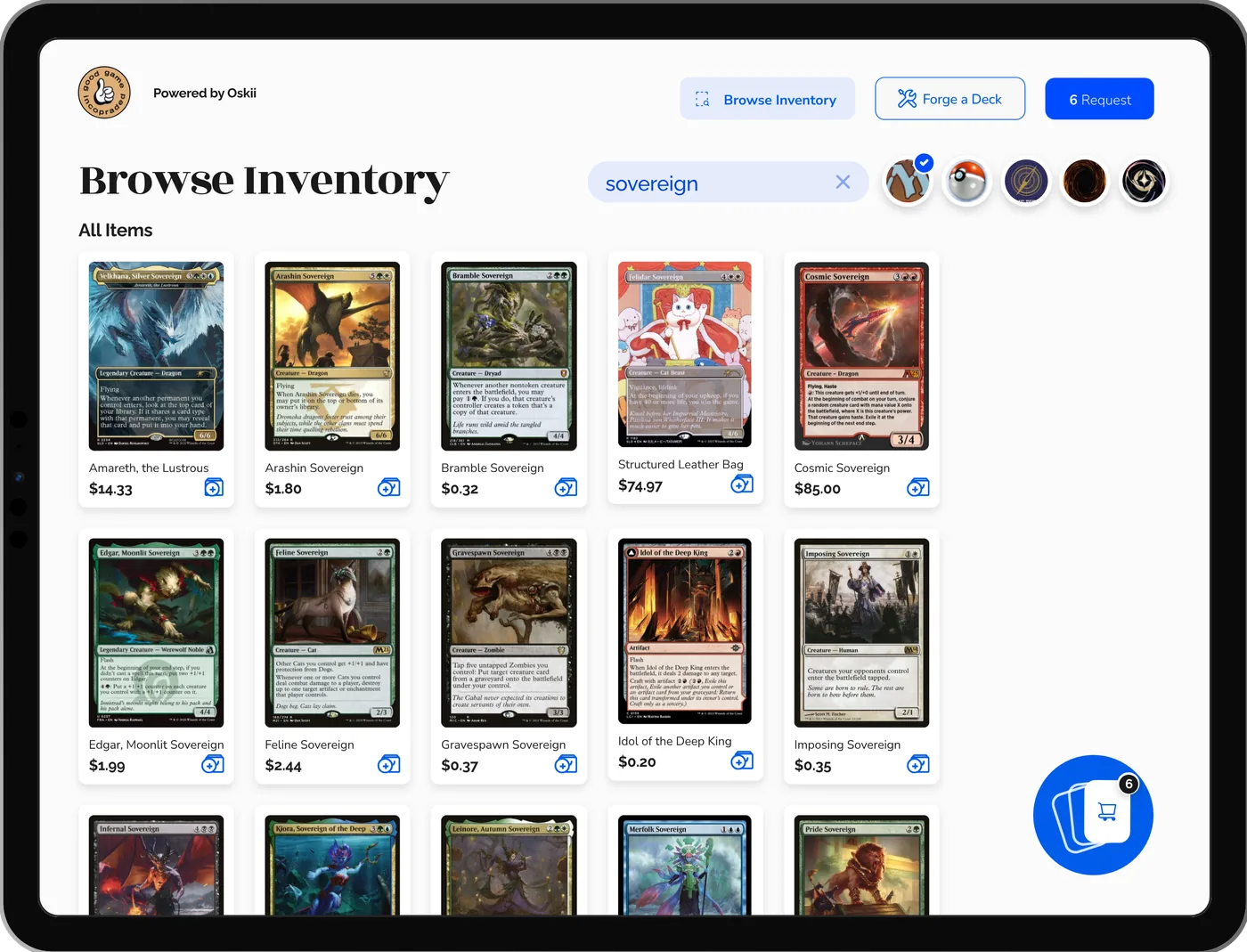
Customers search your shelves, not your staff
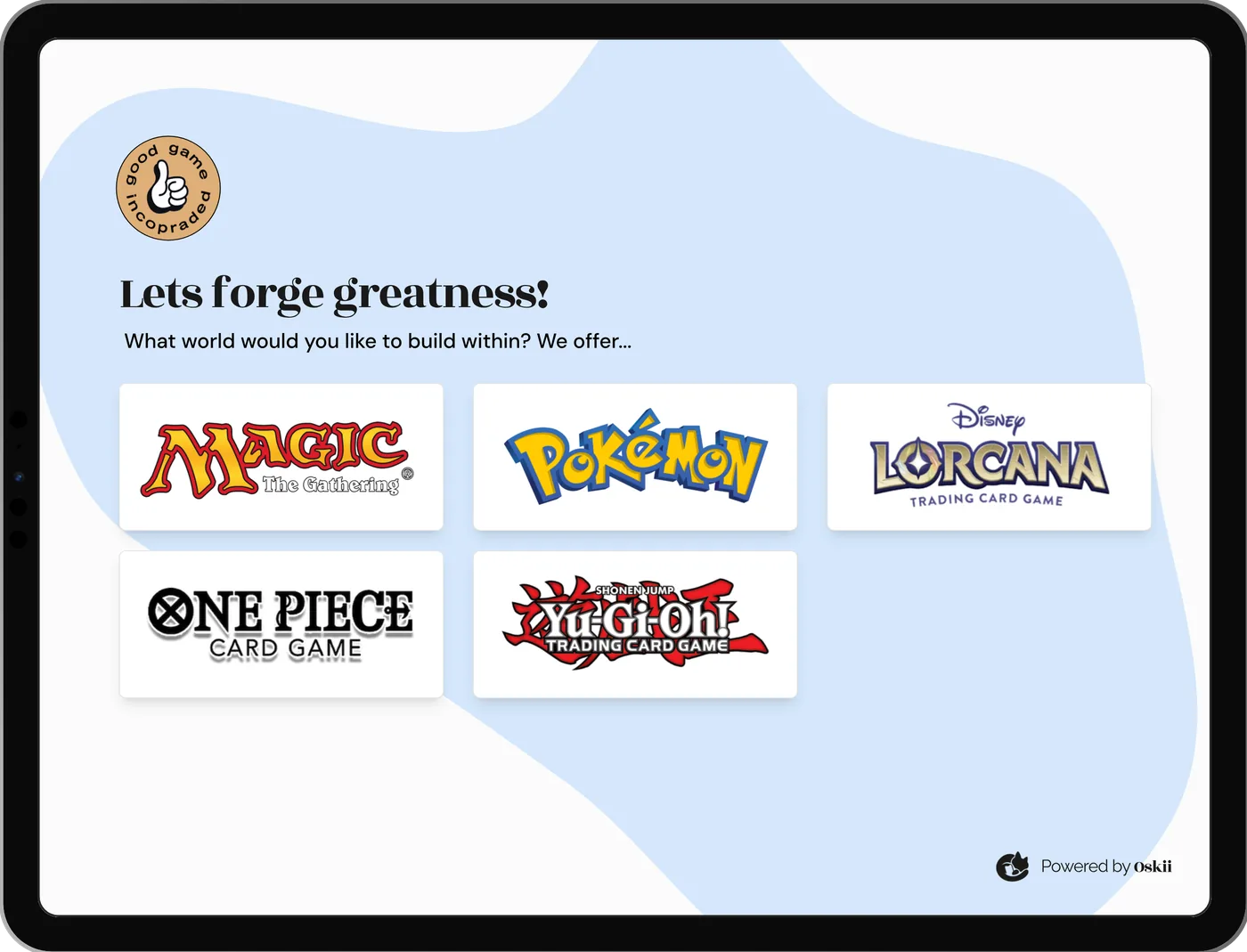
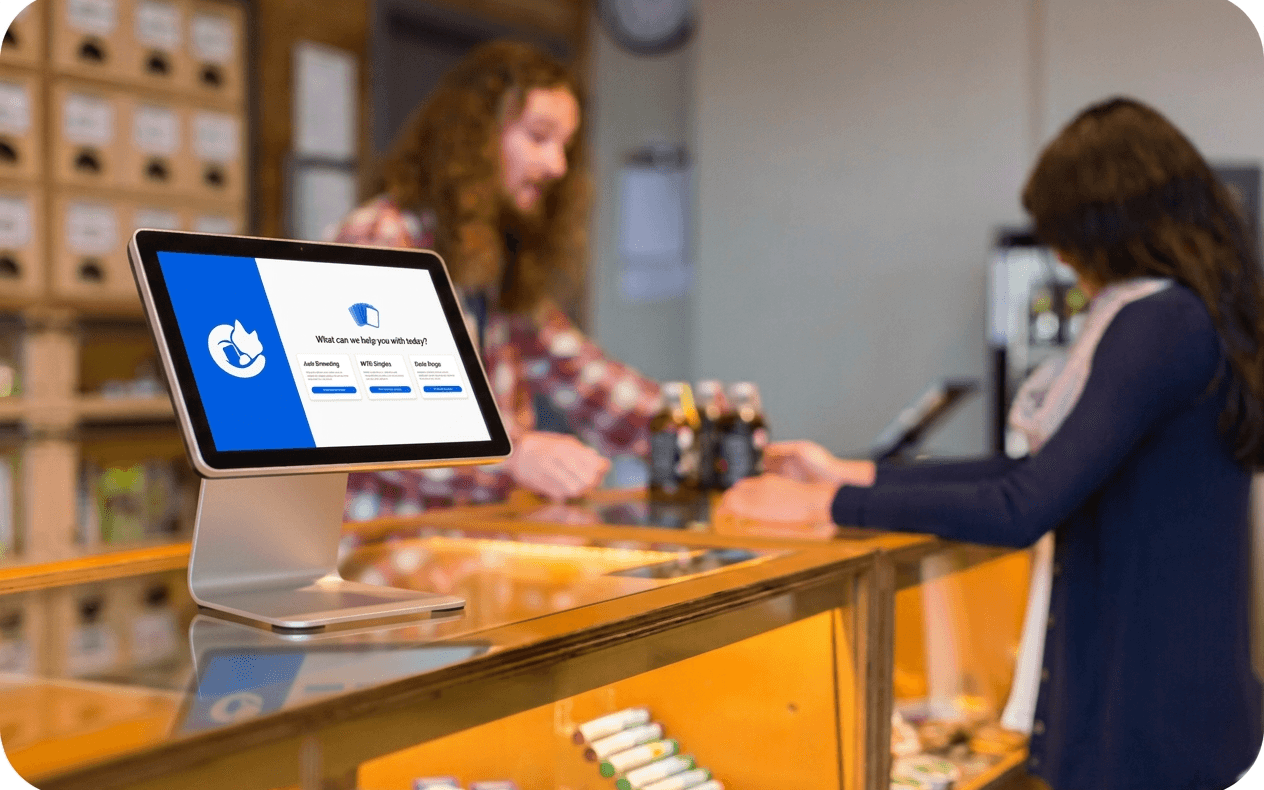
The counter iPad searches the cards that are in your cases and binders right now — by name, set or collector number. What sold this morning is already gone from the screen, so nobody queues up to ask for a card you no longer have.
Live search across every binder, case and bin you hold
Filter by set, finish, condition and language
Daily market estimates on every card — the register sets the real price
The request
The exact printing, held until they reach the register
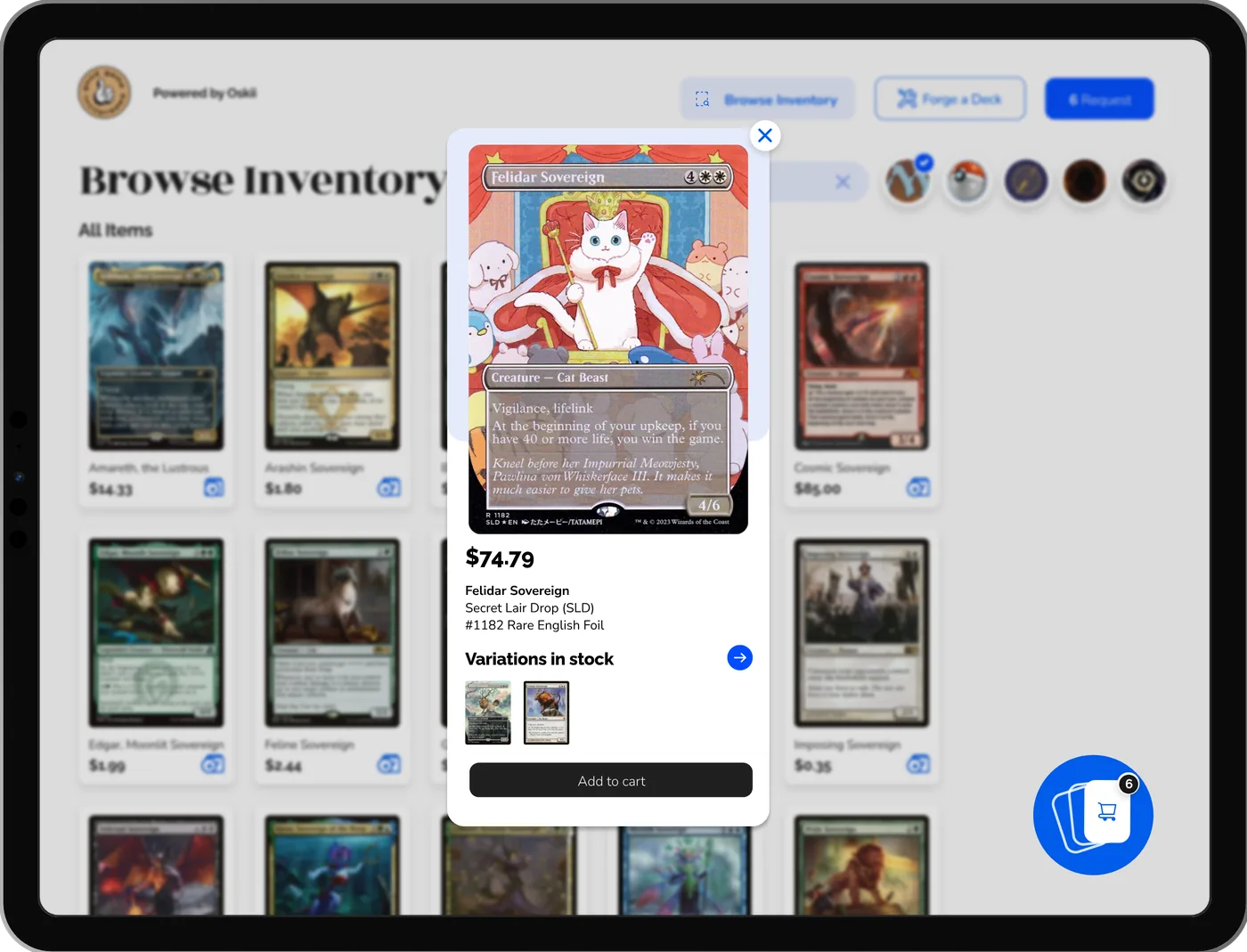
Tapping a card opens every printing you have of it — set, finish, condition and language, each with its own count. Sending the request places a hold on those exact copies, so two customers on two devices can never be promised the same last card.
A hold is placed the moment the request is sent
Availability is on-hand minus held, worked out fresh on every screen
Unclaimed holds expire at close and return to stock on their own
Requested→
Being fetched→
Ready→
Picked up
Behind the counter
A pick list on your own phone, with the bin on every line
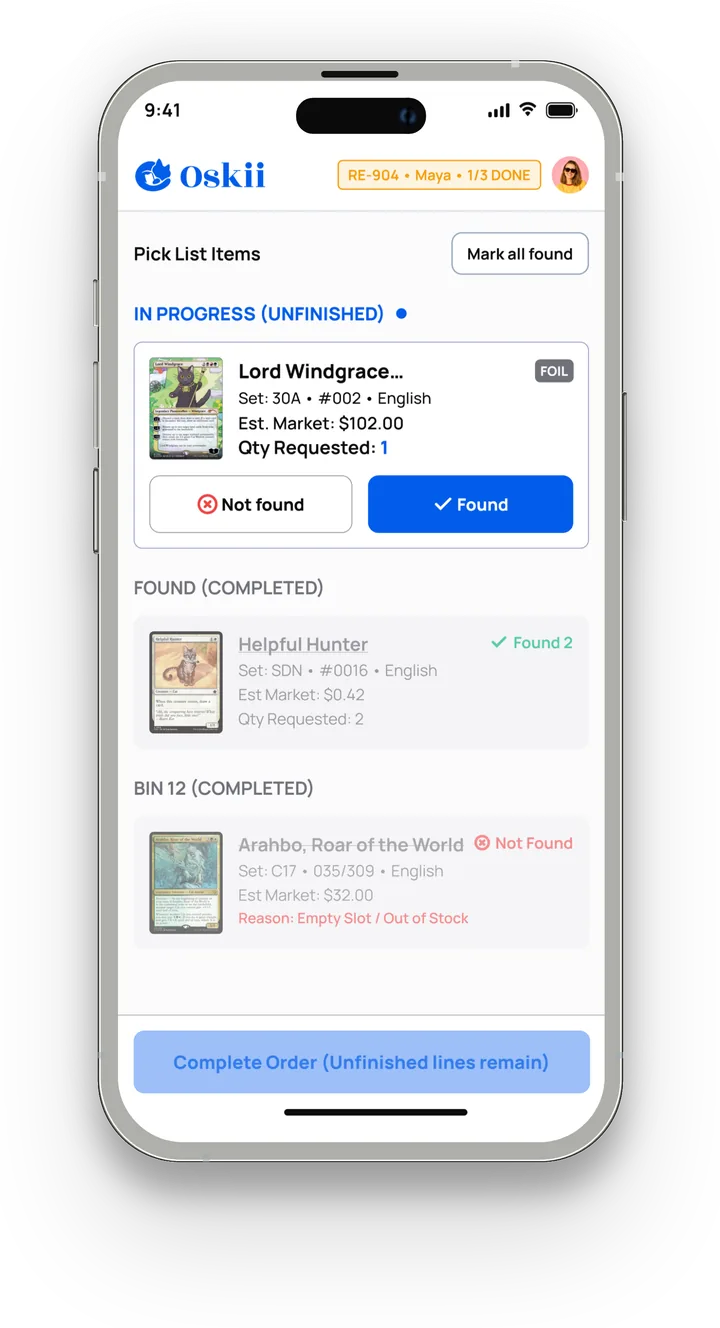
Every request carries a QR code. Scan it, enter your PIN once a shift, and the list opens on the phone already in your pocket — no extra hardware, no terminal to walk back to. Mark each line found or not found, and Oskii hands back the total and the SKUs to key into your POS.
The physical location prints on every line, so nobody guesses which binder
PIN sign-in lasts twelve hours on that device
A partial pull releases only the lines you could not find
On the roadmap
coming later
Deck Forge, built only from what is on your shelf
A Commander deck from a short questionnaire, picked entirely out of your in-stock pool and handed to the pick list as one request. It is on the roadmap rather than in the first release.
Commander decks sized to the stock you actually hold
Gaps are reported honestly, never padded with filler
Arrives after the first release
And the bit nobody sees
Your scanner stays your scanner
Keep scanning intake in ManaBox. Export one binder, upload the CSV or email it in, and Oskii diffs it against what it already knows instead of overwriting you. You see a dry run before anything changes, and an import never drops a customer's hold.
Counts that survive a busy Saturday
Sales reconcile against the next scan rather than being retyped, and anything that does not add up is flagged for review instead of quietly corrected. Oskii is the system of record, so the number on the kiosk and the number in the bin stay the same number.
Honest prices on every screen
Card data and daily market estimates come from Scryfall, refreshed every day and labelled as estimates everywhere they appear — including foil and etched printings, which are priced as the separate stock they are. Your counter still sets what gets charged.
Pick whichever one costs you the most time on a Saturday. Oskii probably has a name for it too.
Oskii for Binder diving
Every card someone asks for is a trip to the back binder, and the queue grows while you flip pages. On the counter kiosk the customer finds it themselves, down to the printing, and your staff make one trip with a list instead of five without one.
Oskii for Stockouts
The kiosk only ever shows what is on the shelf right now, so nobody asks for a card that sold last weekend. Staff stop walking to the case to confirm something is gone.
Oskii for Double sells
Two customers, two devices, one last copy. A request places a hold the instant it is sent and exactly one of them can win it — the other sees the card leave the shelf rather than hearing an apology at the register.
Oskii for Price checks
Daily market estimates from Scryfall sit on every card, so nobody is looking up a price on their phone at your counter. They are labelled as estimates everywhere they appear, because your register still sets the price that gets charged.
Oskii for Wait times
Requests go in while the customer is still browsing. By the time they reach the register the cards are pulled, counted and waiting, and the transaction is a scan rather than a scavenger hunt.
Oskii for Shelf location
Every line on the pick list carries the bin it lives in. Someone on their second shift pulls a card about as fast as the person who filed it.
Oskii for Stock counts
Oskii is the system of record and diffs each scanner export against what it already holds, rather than trusting a retyped number. Sales reconcile at the next scan and anything that does not add up is flagged for review.
Oskii for Imports
Export a binder from ManaBox and upload the CSV, or email it in. You get a dry run before anything changes, a file with problem rows will not apply until someone says so, and an import never drops a customer's hold.
Oskii for Foils
Normal, foil and etched are separate stock, priced separately and picked separately. A foil request is never quietly filled from the nonfoil row.
Oskii for Conditions
Condition and language are part of an item's identity, not a note in the margin. A customer picks the near-mint English copy and that is the exact copy that gets held for them.
Oskii for Status updates
Requested, being fetched, ready, picked up. The customer follows their own request by email instead of standing at the counter asking how it is going.
Oskii for Event nights
Commander night funnels everyone through one register. Requests pile into a single list you can work in one pass between rounds, rather than four interruptions mid-round.
Oskii for New staff
There is no terminal to learn. Scan the request's QR code, enter a PIN once a shift, and the list explains itself — on the phone they already carry.
Oskii for POS keying
Completing a request hands back the total and a SKU list, ready to key into whatever point of sale you already run. Oskii does not ask you to replace it.
Oskii for Deck building
coming later
Deck Forge builds a Commander deck out of your in-stock pool and sends it to the pick list as one request, so a slow afternoon of brewing becomes a few minutes at the counter. It is on the roadmap, not in the first release.